
Drinking and Driving in Canada and USA: What the Latest Data Tells Us
CARSP Webinar Series
Date/Time
Date(s) - December 18, 2025
12:00 pm EST - 1:00 pm EST

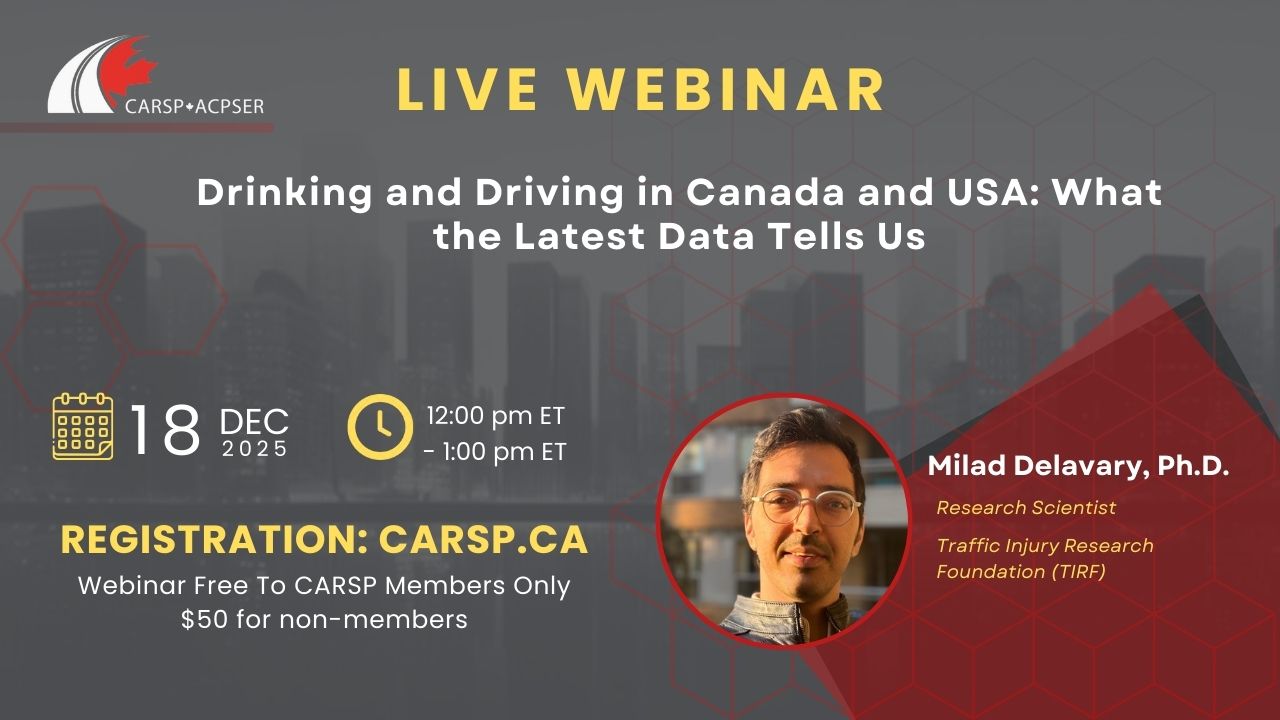
The objective of this webinar is to present the most recent and comprehensive picture of alcohol-impaired driving in Canada, using newly collected 2025 Road Safety Monitor (RSM) data and the updated national impaired-driving fatality trend from 1996 to 2022. The session prioritizes helping Canadian policymakers, practitioners, and community stakeholders understand current levels of concern, self-reported drinking and driving behaviour, and shifts in risk perception among Canadian drivers. To further contextualize these findings, the webinar will also provide select comparative insights from 10 years of U.S. Road Safety Monitoring (2015–2024). These comparisons will highlight similarities and differences in behavioural trends, and supporting evidence-informed prevention and enforcement strategies.
CARSP webinars are free for CARSP members. Webinar recordings are posted 1-2 days after the live webinar takes place. They are immediately available to CARSP members, and after one month, to the general public. Not a CARSP member, you have two options for viewing the webinar. You can pay a one-time $50 fee to watch the live webinar, plus have immediate access to the webinar recording once it is posted. To take advantage of this option, check the applicable box on the registration form. The second option is to join CARSP! Join here.
Speaker

Milad Delavary
Milad Delavary, PHD, PMP, is a Research Scientist at the Traffic Injury Research Foundation, with over eight years of experience in transportation engineering, road safety, public health, and mobility research. Milad holds a master’s degree in transportation engineering, and a Ph.D. from the University of Québec, Canada, with a focus on paramedics’ road safety. He has led international projects evaluating data-driven safety programs and policy interventions. His work bridges engineering, statistics, public health, and behavioural science to advance evidence-based transportation safety solutions.