
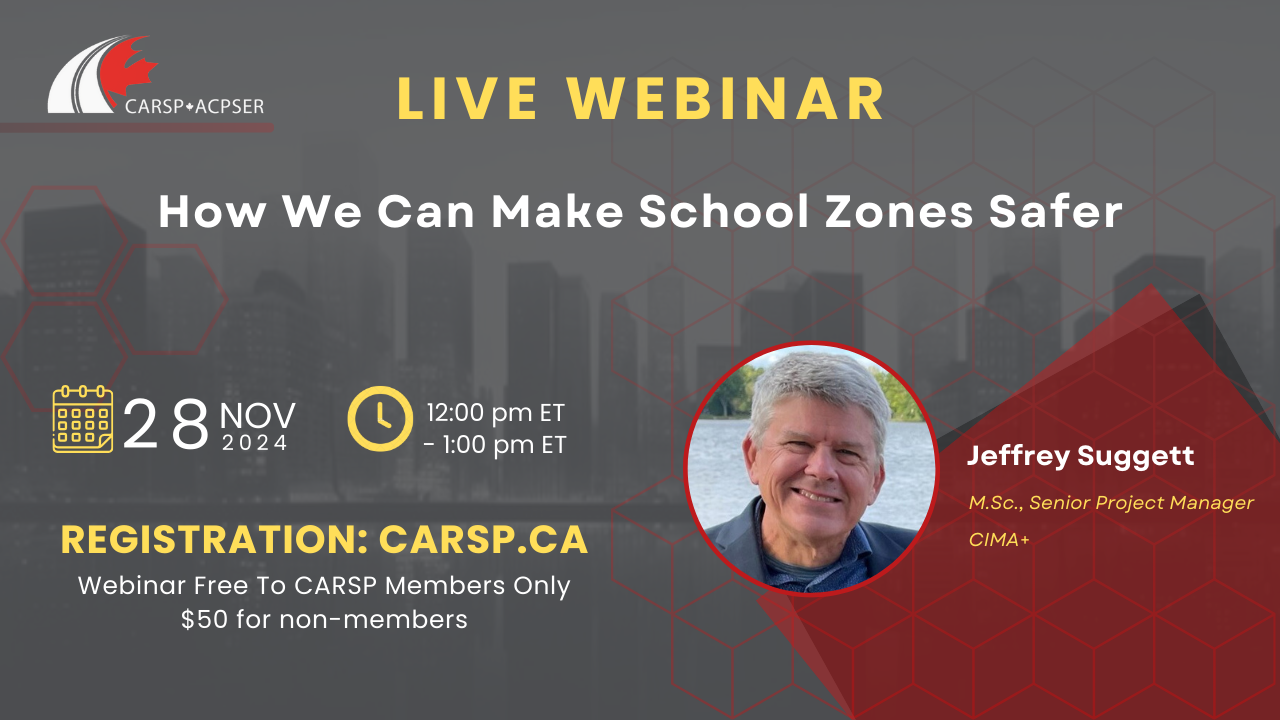
How We Can Make School Zones Safer
CARSP Webinar Series
Date/Time
Date(s) - November 28, 2024
12:00 pm EST - 1:00 pm EST

As part of a broader project undertaken for the City of Vaughan, the Safer School Zone Study, CIMA staff were required to develop a methodology for and identify findings and recommendations for a set of twenty public and private schools identified by the City, referred to as ‘hot spot schools. These schools were identified due to concerns with speed and traffic congestion during the arrival and dismissal periods and concerns raised by school staff and members of the public.
For the hot spot schools, CIMA developed a customized prompt list focussed on three areas, internal school layout, the road fronting the school and the surrounding road network. CIMA staff informed school officials that a site visit was being conducted and then visited each hot spot school and observed arrival and dismissal periods leading up to the morning and afternoon bell and immediately following in addition to reviewing the existing infrastructure and traffic control. In addition, they reviewed speed and collision data to determine the need for additional traffic calming and for justification for pedestrian crossovers.
Based on the field observations, a number of items were identified as working well, however, several recurring issues were identified. Internal to the school, instances of faded or non-existent parking markings and signs were noted along with parents disobeying signs and pavement markings or pylons placed to prevent certain movements. On the roads in front of school, higher operating speeds were noted, excessive congestion and parents parking/stopping in unsafe locations. In the surrounding road network, there were gap in the sidewalk and trail network, an inconsistency in crosswalk markings and curb cuts and an inconsistency in the use of tactile strips and stop bar.
The following broad recommendations were made. Internal to the school, improvements to signs and pavement markings, increased deployment of staff resources (to direct traffic) and physical changes to the internal road network were recommended. On roads fronting the schools, improvements included pedestrian crossovers, no stopping restrictions in undesirable areas, increase no parking and no stopping signage and increased bylaw enforcement. In the surrounding road network, improvements included additional pedestrian crossovers, trail connections, improved consistency with crosswalk markings, removal or addition of curb cuts, and use of tactile strips and stop bars at intersections. The City of Vaughen is currently implementing the treatments recommended.
The ‘hot spot school’ assessments illustrated issues systemic to the entire road network within the school and served as valuable input into the broader Safer School Zone Study. The Checklist used to assess each school, challenges faced, and lessons learned during the project will be shared with webinar attendees. School Zone Checklist
CARSP webinars are free for CARSP members. Webinar recordings are posted 1-2 days after the live webinar takes place. They are immediately available to CARSP members, and after one month, to the general public. Not a CARSP member, you have two options for viewing the webinar. You can pay a one-time $50 fee to watch the live webinar, plus have immediate access to the webinar recording once it is posted. To take advantage of this option, check the applicable box on the registration form. The second option is to join CARSP! Join here.
Speaker

Jeffrey Suggett, M.Sc.
Senior Project Manager, CIMA+
Jeffrey has 25 years of consultant experience in the field of road safety, traffic operations, transportation planning, Environmental Assessments for road infrastructure projects and traffic engineering. He has managed a wide variety of complex technical projects for clients in both the municipal and private sector throughout southern Ontario. Jeffrey has completed and managed a wide range of traffic studies both for municipalities and developers, including traffic input into secondary plans, construction management and staging, traffic input into constructability studies, traffic impact studies, speed and delay studies, queuing studies, traffic operation analysis, corridor reviews and parking assessments.