Young and Novice Drivers
Because of their age and/or inexperience, young and novice drivers are more likely to be involved in fatal collisions. Novice drivers are not necessarily young but could be adults who immigrated from other countries or decided to get a licence later in life.
Prevalence:
According to Transport Canada, the number of fatalities in collisions that were aged 15-24 was 300 in 2023, 15% of all fatalities (Canadian Motor Vehicle Traffic Collision Statistics: 2023). This figure is almost the same as the 2022 (295) and 2020 numbers (294) but lower than the 2015 number by 13%. There were 1,718 serious injuries in 2023, 19% of total, that were aged 15-24, which is higher (7%) than the 2022 and 2020 (13%) figures but lower than the 2015 number (23%).
Unfortunately, there are no collision data specifically on novice drivers.
The figure below shows the percentage of fatalities in collisions involving drivers (15 to 24 years old) in 2020. The data are grouped by type of road user.
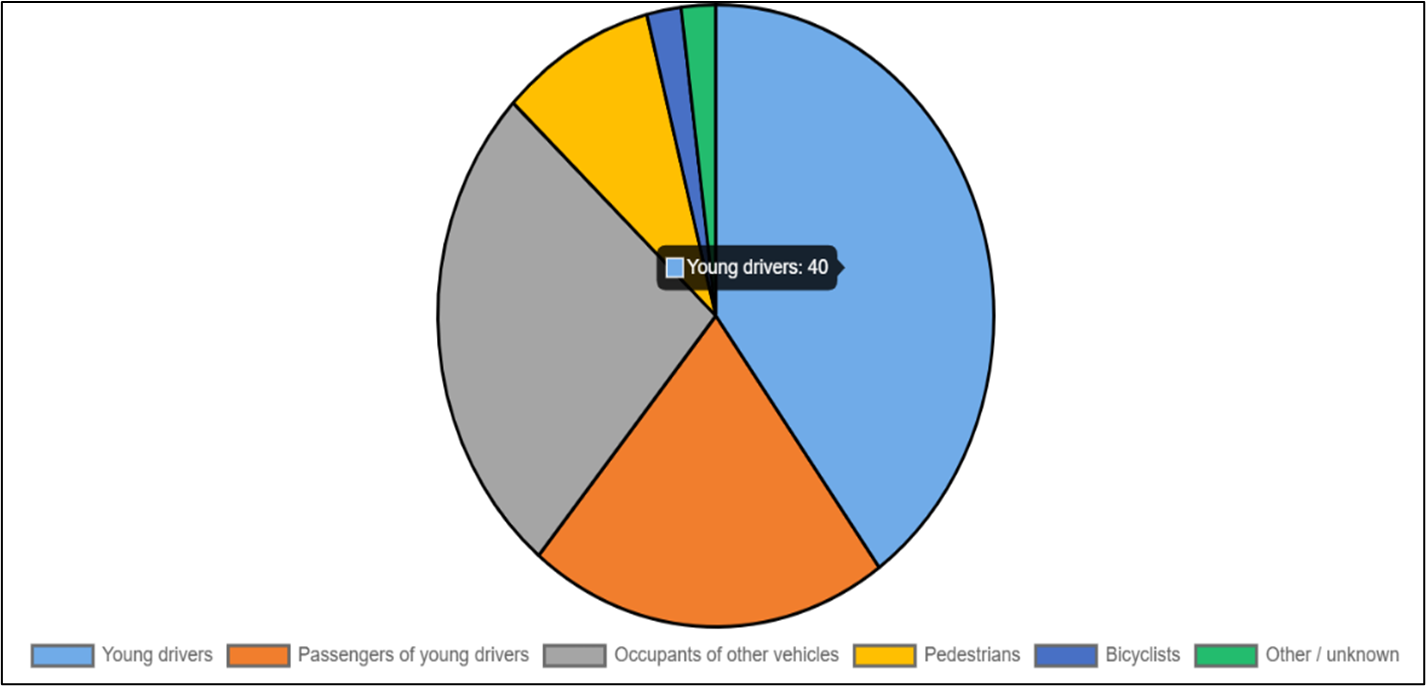
Percentage of fatalities in collisions involving young drivers by road user type in 2020
- 40% of those fatally injured were the young drivers themselves,
- 21% were passengers of young drivers,
- 26% were occupants of other vehicles involved in the collision,
- 9% were pedestrians,
- 2% were bicyclists.
Canada’s 2020 Road Safety Report (Transport Canada)
Countermeasures:
All but one Canadian jurisdiction has Graduated Driver Licensing (GDL) Programs. These GDL Programs allow young and novice drivers to gradually gain driving experience in lower risk driving situations. There is usually a twelve-month novice driver phase. Novice drivers are subject to several rules, including:
- being at least 16 years old,
- only driving with an experienced licensed driver,
- requiring all occupants of a vehicle to wear seat belts.
Typically, the novice driver is restricted from:
- using any alcohol or drugs,
- driving late at night,
- driving with young passengers,
- driving on highways.
After this first phase of GDL, there is a twelve-month “intermediate” or “practice” phase (length varies by jurisdiction). This second phase maintains some but not all the restrictions (e.g., zero blood alcohol concentration, no drugs, and all vehicle occupants must be belted). Some jurisdictions require driving tests at the end of each phase of GDL.
Some jurisdictions like Ontario and Quebec also have a zero-tolerance policy for alcohol and drug use for drivers under 21, even if they have graduated from a GDL Program.
More information about how these GDL programs work can be found on the Traffic Injury Research Foundation’s GDL Framework Safety Center website (GDL Framework - GDL Framework)
These GDL programs have been found to be effective in reducing collisions involving young drivers. GDL Framework - Effectiveness of GDL programs
Manitoba Public Insurance has a high school driver education program, branded “Driver Z” (Driver Z: Manitoba Driver Education Program (MPI)). The program features a progressive curriculum design, new technology elements, and a new delivery model that offers extended, interactive engagement with students.
In September 2019, Prince Edward Island introduced a “Novice Driver Course for Newcomers” for drivers exchanging a driver’s licence from a country that does not have a formal driver licence exchange agreement with the province: PEI Novice Driver Course for Newcomers (NDCN)
There are also many commercial driver education programs across the country. Some of these commercial programs have been approved by provincial governments (e.g., Ontario, Ontario Approved Driving Schools)