
CARSP Conference Awards – 2022
By Alan German, Road Safety Research
At the 2022 CARSP Conference, held from June 19th to the 21st in Sudbury, Ontario, lifetime achievement awards were presented to two CARSP members. Awards were also given for the best papers presented at the conference, and to the winners of the student paper and poster competitions.
Lifetime Achievement Awards
Dainius J. Dalmotas

Following graduation in Mechanical Engineering from Sir George Williams University, Dainius joined the Crashworthiness Division of Transport Canada’s Road Safety and Motor Vehicle Regulation Directorate. Throughout his working career, and beyond, he has been a fervent advocate of a data-driven approach to vehicle safety and has expended considerable effort in integrating real-world collision data with the results obtained from crash-testing programmes. He has conducted collaborative research with several international agencies and is the author of many technical reports and scientific papers. He has received several prestigious awards, including the US Government Award for Safety Engineering Excellence in 1996, an Award of Excellence for An Outstanding Contribution to Transportation in Canada in 1997 and, most recently, the Arnold W. Siegel International Transportation Safety Award for 2019. Dainius has sponsored student paper competitions in both Canada and the US, including a Vehicle Safety Enhancement Award offered in conjunction with the CARSP Conference, with the intention of promoting further vehicle safety research among a new generation of road safety professionals.
Geni B. Bahar
 Geni is a graduate of Civil Engineering at Technion, the Israel Institute of Technology. Over the past 40 years, she has worked globally as a traffic safety engineering expert, project manager, principal investigator, and trainer. Geni is certified as a Road Safety Professional, Level 2, Infrastructure. Her specific areas of expertise include: policy development, pedestrian studies, community traffic studies, value engineering, safety management and network screening, safety reviews and audits. She has participated in a number of national and international safety committees and project teams. Notable contributions include the production of FHWA’s Safety Analyst,
AASHTO’s highly influential Highway Safety Manual, and the development of course and
training materials such as MTO’s The Science of Highway Safety. Geni has memberships in several professional associations including being a Fellow of the Institute of Transportation Engineers (ITE). In 2007, the Transportation Association of Canada (TAC) and Transport Canada named Geni as the Transportation Person of the Year. Geni is a current member of CARSP’s Editorial Committee.
Dr. Charles H. Miller Award
This year’s award for the best technical paper presented at the conference went to Stephanie Cowle, Pamela Fuselli, Fahra Rajabali and Ian Pike, for their paper entitled: The Cost of Transport Injuries in Canada. Given that injury is an important cause of death for Canadians, the authors analyzed the major causes of injury for emergency department visits, hospitalizations, and deaths in 2018 using an incidence-costing, human- capital approach. Cases with transport incidents as an external cause of injury were identified and the results presented by age group, sex, and transport type.
Mavis Johnson Traffic Safety Award
The award for the best paper in the conference’s policy and practice stream was presented to Douglas J. Beirness for his paper entitled: Mandatory Alcohol Screening: Unreasonable Search or Demonstrably Justified? This paper explores the rationale, purpose, and initial impact of the Mandatory Alcohol Screening (MAS) programme in Canada that allows police officers to demand a breath sample from any driver who is
legally stopped, even in the absence of suspicion the driver has been drinking. The research illustrates the challenges of detecting alcohol in brief interactions with drivers at roadside, and the potential value of MAS, and more frequent alcohol checkpoints, in changing the prevalence of driving and drinking and alcohol- involved crashes. Doug is to be especially congratulated for this year’s achievement as it marks the third occasion on which he has received this award (previously in 2008 and 2009).
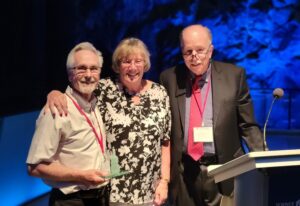
L-R Douglas Beirness, Mavis Johnson and Brian Jonah
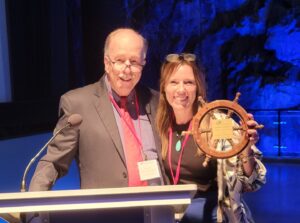
L-R Brian Jonah (MC), Valerie Smith (accepting the Dr. Chares H. Miller award on behalf of Stephanie Cowle)
Student Paper and Poster Winners
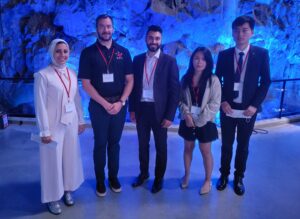
L:R Alia Galal, Michael Stewart , Robert Colonna (Young Professionals’ Committee),
Yifan Wang and Qiangqiang Shangguan
Student Paper Competition – This year’s winner of the student paper competition was Michael Stewart of the University of New Brunswick, for his paper, co-authored by Eric Hildebrand, entitled: The Impact of Different Road Characteristics on Lane Keeping Performance. This study evaluated different pavement marking schemes and road shoulder types under various light and weather conditions to identify those combinations where vehicle-based Lane Keeping Assist (LKA) technologies were no longer able to discern the edges of travel lanes and thus were unable to warn distracted or inattentive drivers. The results suggested that to achieve high percentages of LKA engagement under real-world conditions, the performance thresholds that are currently specified for road surface contrast ratio and retroreflectivity should be raised.
2nd place – Qiangqiang Shangguan, University of Waterloo - A Proactive Lane-changing Risk Prediction Framework Considering Driving Intention Recognition
3rd place – Tate HubkaRao, University of Calgary - Elementary school traffic calming: A Modified Stepped-Wedge Randomized Clinical Trial
Student Poster Competition – The winner of the student poster competition was Alia Galal from the University of Toronto. The poster, co-authored by Birsen Donmez and Matthew Roorda, was entitled: Improving truck driver and vulnerable road user interactions through driver training: A subject matter expert interview study. Interviews were conducted with novice and experienced truck drivers, truck driver trainees (non-licensed), and road safety professionals to obtain their views on conventional training programmes, simulator training, hazard anticipation skills, hazardous scenarios between trucks and VRU’s, and to capture truck driver recommendations. The use of a truck simulator, incorporating more driving scenarios for training, and more on-road practice during training, were strongly endorsed. The incorporation of hazard anticipation training and a VRU safety component were also encouraged by participants.
2nd place – Yifan Wang, Université de Montréal – L’effet modérateur de l’identification au genre masculin sur la relation entre la recherche de sensations et la conduite automobile après avoir consommé du cannabis