
CARSP 2025 Micromobility Panel Summary
Written by Hervé Chapon
Kishan Vandael Schreurs, researcher at the VIAS Institute, presented an overview of Micromobility and Road Safety in Belgium.
There is still confusion with definitions and categorization of the expressions ‘micromobility’ and ‘personal mobility device’ (PMD). The terms encompass a broad range of vehicles including e-scooters, Electrically Power Assisted Cycles (EPACs) and L1eA cycles, PLEV (Personal Light Electric Vehicle) and Light electric vehicles not under European Union (EU) type approval.
Belgian crash statistics (2019–2023) showed that:
- Injury crashes among PMDs increased by 815% from 2019 to 2023;
- Despite a relatively low number of fatalities, many injuries were serious and required intensive care or surgery;
- Underreporting of crashes is significant – only about 10% of incidents were officially recorded.
Crash causes (Based on 100 in-depth cases) were mainly:
- Those occurring at intersections (29%): often due to turning vehicles or priority violations by drivers;
- Unilateral crashes (23%): often caused by infrastructure issues (e.g., potholes);
- Human factors (13%) issues among PMD riders: risky behaviour, consumption of alcohol, excessive speed;
- Other causal factors included: pedestrians crossing in front of PMDs, vehicles overtaking PMDs, car doors unexpectedly opening, and vehicles exiting from private property.
Concerning speeding behaviour, e-scooters were often found to exceed speed limits, especially in pedestrian zones, and speeding was more frequent during calm periods and with shared e-scooters. Riding with passengers was common (among about 10% of trips) despite being illegal.
Injuries for PMD riders were distributed all over the body: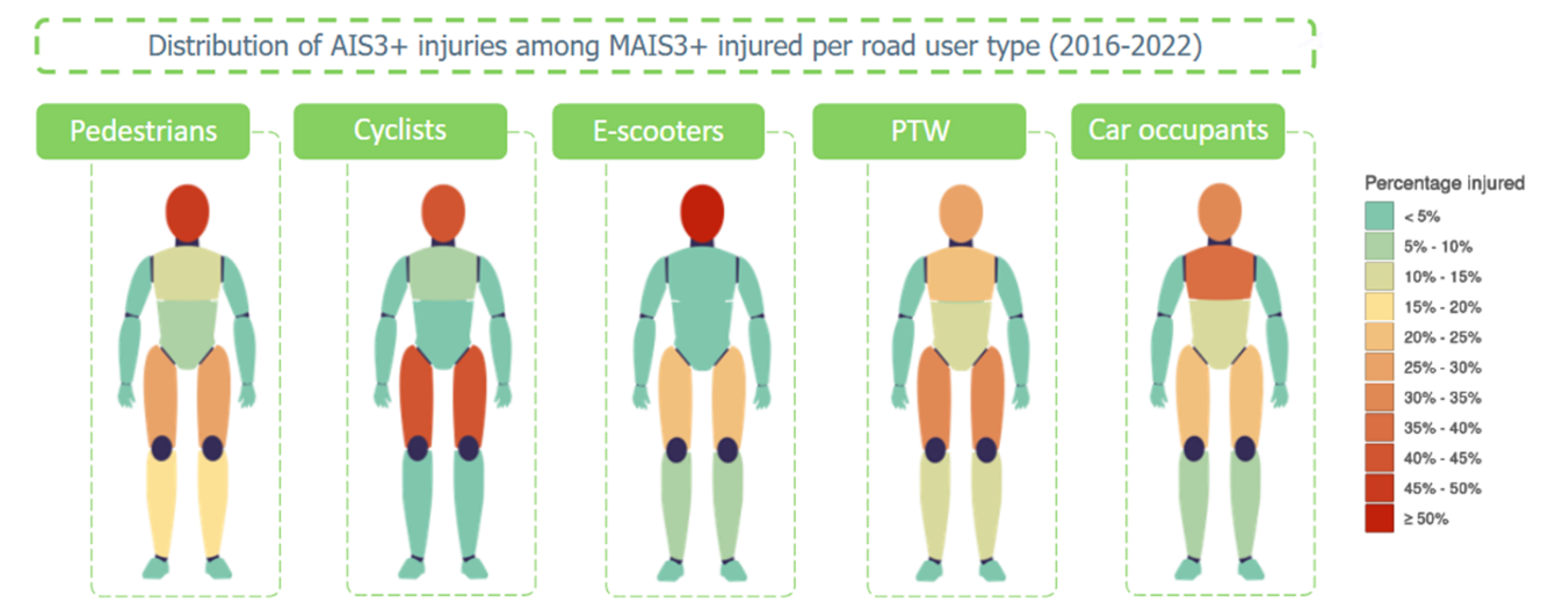
Legal actions and controls for PMDs were made in Belgium:
- Pre-July 2022: basic rules were introduced (e.g., 25 km/h speed limit, forward and rear lighting of PMDs).
- Post-July 2022: sidewalk riding banned, minimum age requirement (16+), no passengers allowed, and regulated parking and speed limits introduced (e.g., 20 km/h within Brussels).
In light of this work, VIAS made recommendations to improve the safety of PMD and other road users concerning:
Safe vehicles
- Standardization and type-approval;
- Features like handlebar indicators, stability control, and geofencing;
Safe infrastructure
- Improved cycle lanes, parking zones, and intersection design;
Safe road users
- Education campaigns targeting youth and urban users;
- Helmet promotion, riding courses, and school traffic education;
- Increased enforcement of driving under the influence (DUI), speeding, and road placement rules.
Dr. Ianto Guy from TRL (UK) presented the future European regulations for PMDs.
TRL, a UK strategic consulting firm, was commissioned by the European Commission to: classify PMDs based on design and usage, to analyze market trends and crash data involving PMDs, to assess the impact of fragmented EU regulations and to propose harmonized technical safety regulations.
Their report put forward key findings and topics on:
Current regulatory landscape
- PMDs are inconsistently regulated across the EU;
- Existing categories under regulation include mopeds, motorcycles, tricycles, and quadricycles and EPACs (up to 250W, assist up to 25 km/h);
Crash and fatality data
- Studies were completed in 2022 mainly with most data coming from Germany, Italy, and France;
- Data inconsistencies across countries limit broader analysis;
Safety recommendations
- Speed and mass limitations for PMDs;
- Minimum controllability and stability standards should be established;
- Mandatory brakes, lights, and audible warnings should be introduced;
Environmental considerations
- Micromobility offers potential environmental benefits;
- Depending on the manufacturer, many vehicles have poor durability, short lifespans, and low potential for recyclability.
- Therefore, TRL suggests considering lifecycle assessments and consumer labeling for energy efficiency and carbon content.
To support mode shift towards increasing adoption of PMDs, regulations should not discourage PMD use by prohibiting passenger transport and by imposing overly restrictive weight limits.
Four regulatory options were considered:
- Do nothing;
- Expand existing regulation;
- Create bespoke approval schemes for PMD types;
- Develop a universal approval scheme for all PMDs.
The expected benefits of harmonized regulation include improved safety and market consistency, an easier compliance for manufacturers in the EU market, and a reduced presence of non-compliant products.
To be fully effective in achieving the goal of eliminating unsafe designs, however, it will be important to require some significant investment in the development of capacity within national approval agencies to issue European PMD approvals, and sufficient enforcement efforts to intercept non-compliant machines.
Prof. Andrew Maxwell from York University explored how micromobility, specifically the SARIT vehicle, can enhance urban safety, accessibility, and sustainability through real-world testing at York University’s Living Lab.
The SARIT is an enclosed 3-wheel electric vehicle (EV) with a 32 km/h top speed and 100 km range, equipped with safety-enhancing technologies like pedestrian recognition and warning sounds, speed control based on location and real-time driver monitoring.
The York’s Living Lab studies security with the campus patrol and parking enforcement, delivery of packages, equipment, and food, student experiential education and technology and adoption validation.
There are many regulatory challenges: SARIT doesn’t fit existing vehicle categories, rules across regions are inconsistent, there’s a lack of clarity for law enforcement, and safety requirements are not unified.
The work of York University’s Living Lab has resulted in four policy recommendations:
- National Definitions: Standardize LSEV categories and specs
- Safety Standards: Develop and test advanced safety tech
- Uniform Framework: Harmonize regulations across provinces
- Living Lab Expansion: Broaden real-world testing and data collection
Jessie Breton, Senior Analyst at àVélo, presented Quebec City e-bike sharing service àVélo and safety initiatives led by the city and the transit authority, the Réseau de transport de la Capitale (RTC).
àVélo, operated by Capitale Mobilité and owned by RTC, was launched in July 2021 with a fleet of one hundred 100% electrically assisted bicycles and 10 modular, easy-to-install and relocate stations.
In 2024, the fleet reached 1300 bikes and 115 stations. The electric bikes were chosen specifically because they could handle the hilly topography of the City. The stations are modular for flexibility and cleanliness.
The growth of àVélo has been spectacular, from 29,000 trips in 2021 to 1.28 million trips in 2024 and a goal of 1.6 million trips in 2025, from May 1 to October 31.
Provincial regulations for àVélo’s services include mandatory helmet use, a maximum electrically assisted speed of 32 km/h and a minimum rider age of 14 years for those with their scooter license or 16 years with a driver’s license.
Since its launch and with the growth of the service, several issues have been identified, including:
- Road sharing conflicts among cyclists, pedestrians, and drivers;
- The requirement to wear a helmet can discourage spontaneous bike use; and
- Challenges with sharing new dedicated cycling corridors (CVC paths) with other users.
To address these issues, the Capitale Mobilité – in partnership with the Réseau de transport de la Capitale – aligned its road safety strategy with those of the City of Quebec and the RTC. The strategy includes awareness campaigns using regular safety tips via social media, enforcement on road user cohabitation and facilities sharing, safe cycling, e-bike rules, alcohol use, and helmet Promotion.
Charles de la Chevrotière, Executive Director of Business and Mobility Strategies at Agence de mobilité durable (AMD) of the City of Montreal, presented how modernizing parking management can help to improve sustainable mobility.
AMD manages parking (on-street and off-street), public EV charging infrastructure, taxi services, and innovation in sustainable mobility. Montreal is evolving its urban mobility to reduce car dependency and knows that parking plays a key role in influencing transportation choices.
The city is shifting from traditional parking management to curbside management. AMD manages a digital inventory of the “curb” (on-street parking) for better management and to prepare for autonomous vehicles, including uses like deliveries, transit, EV charging, micromobility, terraces, and paid parking.
AMD is focused on mobility hubs and parking mutualization, with two ‘mobility hub’ pilot projects of centralized, safe, and accessible spaces offering multiple transport options (bike parking, EV charging, car sharing, etc.) and a goal to convert 150 public parking lots into hubs by 2050. The aim is also to integrate private off-street parking into the public network to optimize usage and improve accessibility.
Recently, AMD introduced license plate recognition (LPR) technology, which will enhance enforcement and data collection and enable virtual permits, remote citations, and detailed curb use analytics. The payment App will evolve to become a full mobility app, integrating real-time data from various transport services and encouraging modal shift by providing better information and pricing transparency.
The City of Montreal has also introduced a modular pricing strategy and aims to manage peak demand, encourage alternative transport, optimize space usage and better understand user behaviour. The agency is leveraging technology and urban planning to support sustainable mobility and reduce car dependency.