
REDUCING SPEED FOR SAFER STREETS: TORONTO’S VISION ZERO PLAN
By: Adam Sweanor
Project Manager - Vision Zero Projects
Transportation Services, City of Toronto
Author Bio
Adam began working for the City of Toronto in 2014 in the Cycling & Pedestrian Projects Unit. In 2020 he transitioned to the Vision Zero Projects team, where he has helped advance various key initiatives. His recent files include the in-road flexible post program, street lighting upgrades on high priority corridors, City-wide speed limit reductions, and proactive identification of the need for pedestrian crossing protection. Adam is also a key member of the team developing guidelines for and delivering quality and consistent customer service to public inquiries. Adam holds a Master’s degree in Urban and Regional Planning from Toronto Metropolitan University and a Bachelor in Business Administration from Trent University.
Abstract
The City of Toronto adopted its first Vision Zero Road Safety Plan in 2016, aiming to eliminate road fatalities and serious injuries. The plan includes a robust speed management strategy, introduced in the Vision Zero 2.0 update in 2019, which incorporates a variety of measures to reduce vehicle speeds and enhance road safety using a data-driven process. Key initiatives include targeted speed limit reductions, automated speed enforcement (ASE) cameras, traffic calming measures, and community-based speed awareness programs. These efforts have led to a reduction in speeding and traffic-related injuries, as evidenced by several studies, including one from the Hospital for Sick Children, which found a significant reduction in pedestrian collisions following speed limit reductions (1). Additionally, the implementation of ASE cameras and flexible speed signs has been successful in reducing speeding behaviour and enhancing safety in targeted areas. Toronto’s multifaceted approach to safe speeds, including roadway modifications, infrastructure improvements, and public education, contributes to the overall goal of reducing and ultimately eliminating road fatalities and serious injuries.
Addressing Speeding and Enhancing Road Safety: Toronto's Vision Zero Plan
Speeding is a significant factor contributing to road fatalities and serious injuries. In Canada, approximately one fourth of all road fatalities are attributed to speed (3). To address this issue, and overall road safety, the City of Toronto adopted its first Vision Zero Road Safety Plan in 2016, with the goal of reducing and ultimately eliminating all road fatalities and serious injuries. This ambitious initiative places a strong emphasis on controlling speeding, particularly in high-risk areas for the most vulnerable road users. The Vision Zero 2.0 Road Safety Plan Update in 2019 built off the original plan and introduced a comprehensive speed management strategy designed to reduce vehicle speeds and improve road safety. This strategy incorporated both short-term and long-term measures aimed at curbing speeding to prevent collisions and prevent the worst outcomes in the event of collisions.
Speed Management Strategy and Toolkit
Various components of the speed management strategy in the Vision Zero 2.0 Plan have been rolled into Toronto’s Safe Speeds Toolkit, a resource available to Toronto residents on the City’s website. The toolkit provides practical tools and strategies that can be used to enhance community safety by lowering vehicle speeds. It offers a variety of solutions tailored to different street types, factoring in variables such as road layout, classification, and local conditions. By evaluating each road segment individually, staff can ensure that speed reduction measures are applied effectively towards maximizing the safety benefits.
Targeted Speed Limit Reductions
One of the elements of the speed management strategy is targeted speed limit reductions. The City took a significant step in this initiative with major roads, where the majority of traffic fatalities and serious injuries take place and where there is the greatest opportunity to enhance safety. Starting in 2019, speed limits on 250 km of arterial roads were reduced, followed by 250 km of collector roads.
To gauge the effectiveness of these speed limit reductions, staff conducted a before and after vehicle travel speed analysis on nearly 250 kilometres of major roadways across the city. The evaluation found that there is evidence that the reductions have had a positive impact on reductions in operating speeds of vehicles.
Following the speed limit reductions on both arterial and collector roads, the focus was shifted to lowering the posted speed limit on local roads where a new approach was introduced using a "neighbourhood gateway signage" method. This strategy allows for blanket speed limit reductions across entire neighbourhoods, with a 30 km/h speed limit applied at entry and exit points of each block or area. Work on this initiative began in 2021 and is expected to be completed by the end of 2028, with priority given to Wards with a higher rate of vulnerable road user injury collisions on local roads.
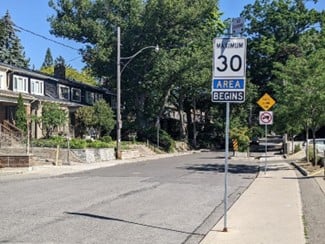

An analysis of local road speed limit reductions to 30 km/h was conducted in 2016 by the Hospital for Sick Children to assess the impact on collision rates with vulnerable road users (1). This study found that roads with a speed limit reduction from 40 to 30 km/h had a 28% reduction in pedestrian-motor vehicle collisions and a 67% reduction in serious injury and fatal collisions compared to those that remained at 40 km/h.
Automated Speed Enforcement
To complement speed limit reductions, Toronto has implemented Automated Speed Enforcement (ASE) as part of the Provincial Bill 65, Safer School Zones Act, introduced in 2018. ASE uses cameras to monitor speeds in designated Community Safety Zones (CSZ), which in 2018 was applied to all school frontages. In 2023 application of CSZs was expanded City-wide with the adoption of a policy framework and in 2024 several new CSZs were approved in areas of concern for older adults. This technology allows for the automated issuance of tickets to owners of vehicles that were observed to exceed the posted speed limit. Warning signs are placed in advance of camera installations and, once operational, ongoing signage reminds people driving of the presence of cameras.
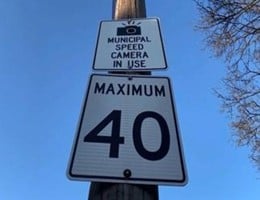
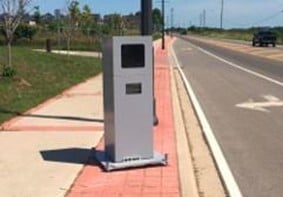
The ASE program has seen significant success. A study done by the Hospital for Sick Children and Toronto Metropolitan University between 2020 and 2022 found that the presence of mobile ASE cameras, along with advance warning signs, had led to a noticeable reduction of 45% in the proportion of speeding, enhancing the safety in targeted communities across Toronto through slower vehicle speeds (2). In 2024, 75 mobile ASE cameras were in operation across the city, resulting in 45,632 tickets issued for speeding violations of 20 km/h or more over the limit. As of 2025, the program is expanding to include 75 additional cameras, with plans for some permanent pole-mounted installations.
Traffic Calming Measures
Another essential component of the City’s road safety plan is traffic calming. This approach focuses on slowing down traffic on collector roads, local roads and laneways making them safer for residents and improving the overall quality of life in neighbourhoods. Toronto’s traffic calming measures include speed humps, speed cushions, and speed bumps and are installed based on factors such as road classification and the types of vehicles that use the road.
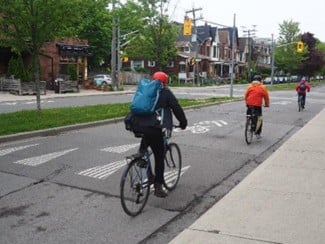
The most common form of traffic calming in Toronto is speed humps, which involve installing a raised mound of asphalt across the full width of the roadway at intervals to encourage a consistent 30km/h travel speed. Demand for the program in Toronto is rapidly increasing, which is in alignment with the roll-out of the 30 km/h speed limit reductions on all local roads in the City. In 2024, 355 speed humps were installed City-wide, and an additional 735 are planned for installation in 2025. Speed cushions are similar to speed humps but include wheel cut-outs to allow larger vehicles to pass over them more easily. These are a new element in Toronto’s toolbox and are deployed on roads where conventional speed humps may not be feasible, such as on bus routes. Speed bumps, which are smaller and intended for low-speed environments (10-15km/h) such as laneways, are another tool used to slow down traffic. These traffic calming measures are both quick to install and effectively create lower speed environments, reduce the overall volume of vehicles, and enhance community safety.
In-Road Flexible Speed Signs
Another innovative speed management tool being used in Toronto are In-Road Flexible Speed Signs. These signs are installed in the center of the road, hardening the centreline and acting as both a traffic calming tool and a reinforcement of the speed limit. The signs have a narrowing effect on the road, slowing down traffic along targeted mid-block segments and improving road safety. This program was first piloted in 2018 with 10 locations and was rolled out City-wide as a Vision Zero program in 2022 following the adoption of a Toronto-specific installation guideline. Following the pilot period, a post analysis found that across 8 locations evaluated, there was an average reduction in travel speed of 10% after 6 months and 6% after 18 months as compared to the pre-installation condition. As well, by displaying the posted speed limit, they remind people driving to be more conscious and monitor their speed. To date, 359 In-Road Flexible Speed Signs have been installed across the City, with another 80 planned to be installed in 2025. Locations for these signs are chosen based on data-driven risk analysis with a focus on mid-blocks with a higher model predicted collision rate and as part of the School Safety Zone program. A small portion of signs each year are allocated to serve requests from Ward Councillors based on community feedback.
Community-Based Speed Awareness Programs
In addition to these various speed management measures, the City of Toronto has introduced programs aimed at raising awareness and educating the public about the importance of lower speeds. Two key programs are the Mobile Watch Your Speed program and the Slow Down lawn sign program.
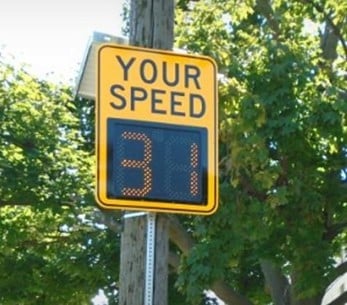
The Mobile Watch Your Speed program features 188 digital display boards that show people driving their speed as they pass the sign. These signs serve as a reminder for drivers to check their speed and slow down if necessary. They are allocated evenly to each Ward and are rotated every 3-6 weeks to maximize the benefit across a range of communities based on requests received through the City’s public request portal or from each Ward Councillor. These signs have been shown to reduce traffic speeds by up to 34% and reduce excessive speeding by up to 18%. (https://secure.toronto.ca/council/agenda-item.do?item=2024.IE18.1) In addition, residents can request "Slow Down" lawn signs to place on their property near the roadway as part of a community-based effort to encourage safer driving. Both programs are designed to remind people driving of their responsibility to follow speed limits and drive carefully through Toronto’s various neighbourhoods.
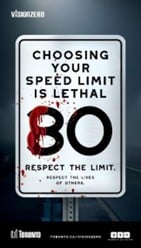
Additionally, the City produces safety guides targeting various road users with important information on how to use key pieces of infrastructure and the roles and responsibilities of various road users. These are available online and print versions are made available at various public consultations and outreach events across the City. The City also produces print and media campaigns focusing on specific elements within the Road Safety Plan. Recent examples include the Dangers of Speeding campaign showcasing a standard speed limit sign overlayed with a streak of red ink that visually raises the speed limit and The Reason for 30 campaign to raise awareness for the ongoing reduction of speeds on local roads through gateway signage to 30 km/h City-wide.
Complementary Measures
In addition to the resources in the Safe Speeds Toolkit, the Vision Zero Plan incorporates measures that, while not directly targeting speeding, can have a traffic calming effect. These measures include the growth of the cycling network, geometric changes to the roadway, providing new sidewalks in areas where none existed previously, and the School Crossing Guard program, which helps ensure children's safety as they walk to and from school.
The City of Toronto installs cycling infrastructure through its Cycling Network Plan, which in addition to making travel by bicycle safer and more inviting can also have a traffic calming effect. Cycling projects often provide an opportunity to implement geometric changes to the road that further calm traffic.
Modifying the layout of the road through geometric changes can include narrowing travel lanes, tightening corner radii, or curb bump-outs. These alterations create a road environment where drivers are naturally prompted to reduce their speed to safely navigate the changes.
The installation of sidewalks in areas where vulnerable road users were previously forced to travel on the roadway significantly improves safety. This infrastructure not only creates a safer environment but also encourages more people to use these paths, who may have otherwise chosen alternative routes or modes of transportation. Sidewalks reinforce the shared use of the road and can have a calming influence on travel speeds, especially when excess roadway space is repurposed to accommodate them.
The School Crossing Guard program improves visibility at key intersections where children are travelling to and from their school. The presence of a crossing guard and children crossing the street serve as a strong reminder to slow down, reinforcing safer driving speeds around school zones.
Together, these measures repurpose excess roadway space that might have otherwise encouraged speeding, creating environments where drivers naturally adjust their behaviour to the new conditions. When combined with measures from the Safe Speeds Toolkit, these changes create a self-enforcing system where drivers are less likely to speed due to both physical road design changes and heightened safety awareness.
Conclusion
Toronto’s Vision Zero Road Safety Plan represents a comprehensive effort to eliminate road fatalities and serious injuries and improve safety for all road users. It is acknowledged that many of the tools are limited to local roadways only, which is why staff are always looking for additional tools and piloting new measures to add to the toolkit to address speeding on higher order roadways. In addition, to better address speeding on higher order roadways, Toronto is a funding partner on a project led by Transportation Association of Canada, which aims to develop a synthesis of practice for Design and Operation of Lower-Speed Collector and Arterial Roads.
As speed management initiatives continue to roll out and expand, a multi-faceted approach combining roadway modifications, infrastructure improvements and education, is key to achieving safer streets for Toronto’s residents. The ongoing success of these measures, coupled with active participation from various communities, will help the city move closer to its ultimate goal of zero road fatalities and serious injuries.
References
- Fridman L, Ling R, Rothman L, Cloutier MS, Macarthur C, Hagel B, et al. Effect of reducing the posted speed limit to 30 km per hour on pedestrian motor vehicle collisions in Toronto, Canada - a quasi experimental, pre-post study [Internet]. BMC Public Health. 2020;20(1):56. [cited 2025 Feb 28]. Available from: https://bmcpublichealth.biomedcentral.com/articles/10.1186/s12889-019-8139-5.
- The Hospital for Sick Children Research Institute. The City of Toronto Automated Speed Enforcement Program Evaluation [Internet]. Toronto: The Hospital for Sick Children Research Institute; 2023 [cited 2025 Feb 28]. Available from: https://www.toronto.ca/wp-content/uploads/2023/07/96cc-Automated-Speed-Enforcement-Program-Evaluation.pdf.
- Transport Canada. Canadian Motor Vehicle Traffic Collision Statistics: 2022 [Internet]. Ottawa: Transport Canada; 2022 [cited 2025 Feb 28]. Available from: https://tc.canada.ca/en/road-transportation/statistics-data/canadian-motor-vehicle-traffic-collision-statistics-2022.