
Slower Speeds, Safer Streets: Ottawa’s Commitment to Road Safety
By:
Heidi Cousineau P.Eng.
Manager, Traffic, Safety & Mobility
Traffic Services, City of Ottawa
Abstract
The City of Ottawa is advancing road safety through a multifaceted approach that integrates Automated Speed Enforcement (ASE), comprehensive traffic calming programs, and street design improvements. Rooted in the Safe Systems Approach, Ottawa’s Road Safety Action Plan (RSAP) aims to reduce speeding, prevent fatal and major injury collisions, and create safer streets for all road users. Key initiatives currently include reducing speeding by expanding ASE in high-risk areas, implementing both temporary and permanent traffic calming measures, and designing residential streets for a 30 km/h operating speed. This article explores Ottawa’s data-driven strategies and the tangible impact these measures have on driver behavior and community safety.
Introduction
Slower speeds, safer streets—Ottawa is taking significant steps to enhance road safety through automated enforcement, expanded traffic calming measures, and design improvements.
The City of Ottawa’s Road Safety Action Plan (RSAP) is a data-driven strategy designed to improve road safety for all users by addressing key risk factors, including speeding. Rooted in the Safe Systems Approach, the RSAP focuses on engineering, enforcement, education, and culture change to reduce fatal and major injury collisions and create safer streets.
To support this vision, the City of Ottawa has implemented several targeted initiatives aimed at managing vehicle speeds and enhancing road safety. These initiatives include Automated Speed Enforcement (ASE), the Temporary Traffic Calming program, the Neighbourhood Traffic Calming Program, and the 30 km/h street design guidelines, among others.
Automated Speed Enforcement (ASE)
ASE is one of several tools used by the City of Ottawa to reduce speeds, modify driver behaviour, and enhance road safety.
In Ottawa, speed cameras are strategically placed in community safety zones near schools or parks—areas where speeding poses a risk to our most vulnerable road users, particularly children.
The City began with a pilot project of eight sites between July 2020 and July 2021. Following the evaluation of the pilot program, the City Council approved the ASE program in October 2021.
A recent analysis of the initial ASE pilot sites demonstrates that the longer the speed cameras are in place at these locations:
- The more drivers are obeying the regulatory speed limit of the roadway; and,
- There are fewer instances of drivers travelling more than 15 km/h above the posted speed limit (i.e., ‘High End Speeding”).
Fines vary based on the recorded speed over the posted limit, increasing as the amount of speeding increases. Since speed cameras are installed in Community Safety Zones in Ottawa, the set fine portion is doubled to further discourage speeding.
The following table provides further details on changes to driver behaviour experienced at the original ASE pilot sites since the speed cameras were installed.
Table 1 - Driver Behaviour at Automated Speed Enforcement Pilot Sites
|
From Speed Camera |
Compliance with Posted Speed Limit |
Instances of High End Speeding |
| Prior to | 16 per cent | 14 per cent |
| Within Three Months | 57 per cent | 4 per cent |
| After 1 Year | 69 per cent | 2 per cent |
| After 3 Years | 81 per cent |
<1 per cent |
The ASE program first saw the implementation of speed cameras at locations adjacent to school areas and it has since been expanded to include locations adjacent to parks and playgrounds. A pilot study is currently underway to assess the effectiveness of ASE cameras in reducing high-speed driving and street racing on major roadways—not just near parks or schools. Location selection was based on factors such as collision history, documented speeding issues, proximity to schools, and feedback from the Ottawa Police Service. As part of this study, ASE cameras were installed at four locations throughout 2024.
Building on the success of previous pilot projects, Ottawa is expanding its ASE program by installing additional speed cameras citywide, to deter speeding and improve safety. In 2025, a pilot project will start in four rural village locations. This expansion reflects the city's commitment to leveraging technology as a key tool for fostering responsible driving behaviour and enhancing road safety.
The City currently has 60 speed cameras in operation, including the four pilot locations, to assess the effectiveness of speed cameras on high-speed corridors. A total of 24 new speed cameras in the vicinity of schools, as well as the four pilot locations in rural villages, are planned to be installed in 2025.
Comprehensive Traffic Calming Programs
Ottawa employs a multifaceted approach to traffic calming, encompassing both temporary and permanent measures.
Temporary Traffic Calming Program
The Temporary Traffic Calming (TTC) Program implements effective, low-cost, temporary or seasonal traffic calming solutions that can be quickly and easily modified to address speeding concerns. The TTC Program provides solutions for areas that may not qualify for permanent roadway modifications or require immediate intervention while long-term solutions are developed. Example measures include speed display devices, pavement markings, and flexible centerline signage.
Each Ward Councillor receives an annual budget for the TTC Program. In 2025, each Ward was allotted a budget of $87,500. Implementation locations and specific measures are determined by the Ward Councillor in consultation with residents and TTC Program staff.
Since 2015, there have been almost 4,000 locations city-wide that have had measures installed through the TTC Program including over 940 speed display boards.
Neighbourhood Traffic Calming (NTC) Program
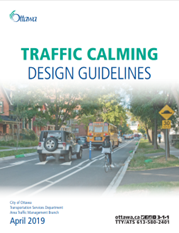
The Neighbourhood Traffic Calming (NTC) Program addresses requests for permanent, engineered, and localized traffic calming solutions on existing local and collector streets within neighbourhoods. This Program is reserved for streets that are not scheduled for infrastructure rehabilitation where the roadway would be redesigned following the City’s Complete Streets policies. Typical measures include vertical deflection measures (e.g., raised crossings, speed humps, speed cushions, etc.) and/or horizontal deflection measures (e.g., chicanes, medians, curb extensions, etc.), all designed to reduce vehicle speeds and improve safety.
The NTC Program has developed a process for managing requests for permanent engineered traffic calming in a fair and consistent manner. This involves both qualification and city-wide prioritization of all requests. The process prioritizes resources based on addressing the most severe problems first.
In alignment with the City of Ottawa’s Road Safety and Complete Streets objectives, the NTC Program primarily focuses on addressing concerns related to vehicular speeding. Traffic volume concerns may also be considered, provided that vehicular speeding is evident.
Streets that qualify and are prioritized for engineered traffic calming measures will first undergo a Neighbourhood Traffic Calming Study, which evaluates technical solutions and builds community consensus for a recommended traffic calming plan.
The City of Ottawa has operated this program since 2004, with its most recent update in 2019. In 2023 and 2024 combined, over 100 individual traffic calming measures were constructed following multiple studies completed through this program.
Designing Streets for Safety: 30 km/h Guidelines
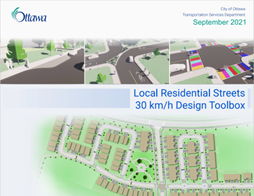
In alignment with the City of Ottawa’s Road Safety Action Plan (RSAP), all new or reconstructed residential streets will be designed for a 30 km/h operating speed. The Local Residential Streets 30 km/h Design Toolbox builds on existing City guidelines and policies, including the City’s Traffic Calming Design Guidelines, to help achieve this target. It incorporates design elements such as road narrowings or curb extensions (i.e., localized narrowing only), traffic calming features, and enhanced pedestrian crossings to naturally encourage lower speeds and create safer, more livable neighborhoods. The Design Toolbox assists planners in selecting the most effective combination of speed management measures based on context, implementation frequency, and compatibility with complementary features.
In 2023 and 2024 combined, 6.6km of local residential roads were reconstructed to meet 30km/h designs through multiple integrated road, water, and sewer renewal projects. Just over 15km of new local residential roads to be built by developers were designed and reviewed to meet 30km/h designs in 2023 and 2034 combined.
Through these comprehensive initiatives, Ottawa remains committed to improving road safety and creating safer streets, fostering a secure environment for all road users.